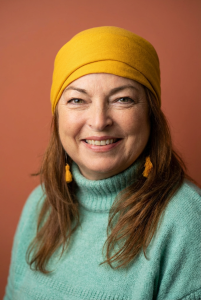

Professional Profile
Isabel Pérez-Doherty is an Ecuadorian Colombian economist and Social Impact Consultant based in the Whitby–Toronto region. Trained in economics, she redirected her career from numbers to social and environmental action, with a focus on community centred development and the care economy.
Her professional path has taken her through Spain, the Dominican Republic, the United Kingdom and Canada. She worked with the Jesuit education and social justice network Fe y Alegría, first in low income communities in Ecuador and later with its international network from the Dominican Republic, accompanying projects across Latin America. In the UK and Spain she refined her ability to translate Latin American experience for European employers, navigating bias and credential gaps.
Now in Canada, where she arrived about a decade ago, Isabel works as a Social Impact Consultant and investor in impact driven companies, specializing in fundraising strategy and philanthropy. She also coaches and mentors professionals – especially Latina women – and builds support networks that connect international talent with opportunities. Her work promotes social and environmental impact, as well as Latin American unity and visibility, as strategies for belonging and shared progress.
Isabel Pérez’s first Canadian encounter takes place in a library. It is not by chance. Newly arrived, she walks up to the counter and asks for more than books. She is looking for guidance. There she finds a mentorship program for international professionals and, within a month, she has a mentor. That gesture – going straight to the institution that organizes knowledge – changes everything: less trial and error, more method; less isolation, more support network. “That culture of generosity shaped me,” she says. The starting point is not a job offer or a business card; it is a sustained connection.
Her story matters in the Canadian and Latin American context because it addresses skilled migration without romanticizing it. It reveals grief, names bias, and proposes a practical framework – mentoring, coaching, gradual goals – so that talent is not lost in survival jobs. It also connects two agendas that often run in parallel: protecting the social fabric and caring for the environment. In Isabel’s case, both planes intersect in an ethic of care that she chose early as her professional compass.
Isabel grew up in a middle class family with, as she puts it, “very limited opportunities.” She chose economics, convinced that it contained tools to understand development. But the models were not enough. “The economics in books did not reflect the reality of people or of finite resources,” she explains. The gap between theory and life pushed her toward the field. She worked with the Jesuit education network Fe y Alegría, first in low income communities in Ecuador and then with the international Fe y Alegría network from the Dominican Republic. That experience cemented two convictions: development is community based or it is not, and the planet is not an accounting appendix.
The first migration – to Spain – was, she recalls, “the hardest.” Sharing a language did not soften the culture shock. There was racism, exclusion and very few support networks. From that period she retains a concept she now repeats to anyone who will listen: migration is always “a grieving process,” regardless of the educational or social capital of the person who moves. Grief for what is left behind, for what does not work on the first try, for what takes time to rebuild.
In the United Kingdom, the challenge changed shape. English, prejudices, unfamiliar credentials and countries that felt “unfamiliar” to some recruiters all played a role. There she learned to translate not only vocabulary but trajectories: a Latin American CV needs context, and distrust is countered with evidence and patience. Each move forced her to reinterpret her own story without diminishing it.
Canada was something else. Isabel arrived, she says, “as an experienced migrant.” She already knew what to ask, how to activate support networks and who to approach for advice. The library and the mentorship program became her first anchors. The second was a professional decision: redirecting her energy toward the social, human and environmental sector, this time within an ecosystem that can value international experience when it is deliberately organized and clearly explained. At the same time, she deepened a belief that had already taken root: “No one moves forward alone.”

That support did not appear by magic. It had to be sought out, invested in and sustained. “In my case, mentorship and coaching were fundamental,” she says. They helped not only to set goals but also to practice difficult conversations – salary negotiations, understanding power dynamics, managing imposter syndrome – that often stall careers before they can begin. “The main challenge is the constant need to prove your worth,” she admits. For migrant women, that test is even more severe: external bias piles onto internal doubt. Having “professional women” who advised her at those boundaries changed everything.
The path she followed is neither linear nor spectacular. It is sustained. Spain, the Dominican Republic, England, Canada: four landscapes in which she refined a method she now shares with others. Step one: build a community with purpose. “Look for people who uplift you and whom you can also uplift,” she recommends. The solidarity she proposes is not the insularity of a private contact list; it is collaboration that opens doors and, above all, shares information. Step two: separate the present from the destination. “Your current job does not define your future,” she insists. A temporary job can be a stepping stone, not a label.
Step three: invest in yourself with the same seriousness you would invest in a project, through training, coaching and professional networks. Step four: ask for help – not as a favour, but as a learning strategy. Behind each of these steps lies a refusal to let grief turn into paralysis. “If others could do it, so could I,” she tells herself in the hardest moments. It is a form of hopeful realism that forced her to reinvent herself several times, to change approaches without losing her ambition to contribute and grow.
The Latin American thread in her story is not just an identity marker; it is a driving force. Isabel speaks of “greatness and unity” when she thinks about the community in Canada. Greatness lies in the diversity of contributions – from agriculture to social leadership and business. Unity lies in the ability to celebrate each other’s achievements as collective triumphs. Here her diagnosis is clear: “We need to make these stories more visible.” Visibility, properly understood, is not marketing; it is relational power. Better told stories lead to stronger references, more open doors and fewer careers stalled for lack of translation.
There is also a pedagogy of error running through her narrative. Isabel acknowledges many moments of doubt – about whether to continue, whether the effort was worth it. International cooperation and the migration process itself can be exhausting. What sustained her was a simple creed: learning from others’ paths and treating her own adjustments not as failures but as iterations. She speaks about it without fanfare, like an honest accounting of costs and benefits.
In Canada, that balance has tipped toward learning. Early mentorship, a culture of institutions that offer bridges, and a network of women who share knowledge ignited something in her. “That culture of generosity shaped me,” she repeats. Shaping, in this case, means changing practice. She moved from academic economics to the care economy: designing programs that protect people and the environment; thinking about how to integrate international professionals without wasting their human capital; addressing bias with procedures rather than slogans.
The verifiable achievements that emerge in her story paint a coherent picture: a background in economics; a decisive shift toward the social, human and environmental sector; work with Fe y Alegría in Ecuador and with its international network from the Dominican Republic; migration through Spain, the Dominican Republic, the United Kingdom and Canada; activating a mentorship program within the first month of arriving; sustained investment in coaching and networks to negotiate with better information; and, as a result, a career that can reorient without losing its purpose. There are no awards at centre stage; there is structure.
This emphasis on architecture is also reflected in how she understands imposter syndrome. She does not deny it or dramatize it; she manages it. For Isabel, the remedy is not to pretend the feeling does not exist, but to create conditions that weaken it: better information for negotiation, mentors who help anticipate scenarios and safe spaces where one can practice their own voice. Part of that practice involves clearly asking for the recognition that is due. “There is doubt about whether your abilities are sufficient,” she notes; dispelling it requires facts – results, processes – and conviction.
Her message to a newly arrived Latina crystallizes this experience. First, community. Second, horizon: separating the present from the future. Third, personal investment: “believe in yourself” not as a slogan but as a principle, and allocate time, money and energy to training and networking. Fourth, mentors: “talk to those who have already walked this path.” And a reminder that puts individualistic success narratives into perspective: what you do is part of a chain; your contribution is a grain of sand in an ocean of collective efforts.
The final image returns to that first week in the library. There is something symbolic about that scene: a country that offers a mentorship program; a professional who understands that asking for guidance does not diminish her; and a community that grows stronger when it turns that gesture into habit. “Canada has been more welcoming,” she says. The welcome, however, does not replace the work. For Isabel, the welcome provided the framework; she provided the method. Together – institutions that open up and migrants who plan – they produce a real sense of belonging.
There is no moral at the end of the story, but there is a phrase that captures her philosophy: “No one moves forward alone.” In her voice, it does not sound like a slogan. It sounds like design.